3 out of 5 stars
“Compulsively readable.” You see that quite frequently in front cover (or back cover, whichever) blurbs, but what exactly does that mean? And can it really apply to so many books? Well, I can't answer for the second question, but as to the first, I would say the phrase describes something that can't be put down; a book that one keeps reading well into the wee hours of the night, perhaps even until the first rays of dawn peek through the windows. If the “compulsively readable” phrase gets tossed around too much until it loses some of its punch, in the case of Harold Schechter's The Mad Sculptor it is thoroughly deserved and 100% true.
And yet...
After a while, the story begins to slow down, especially when it comes to the detailing of Robet Irwin's, The Mad Sculptor himself, many stints in mental institutions and his movements in between those stints. The whole thing becomes so tedious after a while, you begin to wonder exactly what kind of story Schechter is trying to tell. Especially when he includes the stories behind the many murders that occurred in the same Beekman Place neighborhood as where Irwin killed Veronica Gedeon. Don't get me wrong, I enjoyed those side excursions, but to me all it did was muddle the direction of the book. When I reached the end, I wondered what exactly was the point. If Schechter wanted to explore the strange history of Beekman Place and why so many murders occurred in such a short period of time in the early part of the 20th century--was the neighborhood cursed? Did it have anything to do with the deprivations of the Great Depression? etc.--which I would've found interesting, then why focus so much on Irwin? If Schechter wanted to explore the psychopathy of Irwin, why did he peel off so many times to focus on those other murders, in which Irwin wasn't involved? It just came off as messy and uneven. Which is strange because I've read several of Schechter's other true crime books and have always found him to be both informative and entertaining, with a very readable narrative. Certainly nothing like what I encountered in The Mad Sculptor.
Read from January 26-February 1, 2014
Reviewed for the Amazon Vine Program March 19, 2014
Wednesday, March 19, 2014
"The neglected Infanta was about to become the most courted woman in England, the Queen, the bride of the most handsome, the most kingly ruler in Christendom."

2.5 out of 5 stars
If I'd read this compilation (or the individual novels) about twenty years ago, before I'd studied and read so much concerning Tudor history, I probably would've enjoyed it more. As it is, I just know too much and have too many suppositions and theories of my own; whenever I came upon points of contention, I would say to myself, "Ah, so she went with this version of that event. Okay, so she used this birth date rather than the later one." And so on. So while I can appreciate that Plaidy was an excellent author insofar as creating believable characters and a compelling narrative, her biases ruined the overall experience as they made for rather one-sided characters, especially when it came to Henry VIII. Yes, he was a bastard, there's no doubt about that, but Plaidy's version was almost a caricature--his behavior and personality was just so over-the-top, it was cartoonish. And of course Plaidy went with the standard (at the time) portrayal of "mad" Juana, Katharine's sister, a woman whose image was thoroughly tarnished and maligned by those who purported to love her, who is now becoming somewhat rehabilitated. Not to mention Plaidy had a habit of repeating either information (in what is probably one of the earliest examples of the "As you know, Bob" exposition, I'm guessing), dialogue, or, the most egregious, descriptions. I stopped counting after about the tenth use of "piggy" to describe Henry's eyes. In a way, I believe Jean Plaidy was the Philippa Gregory of her time: she was able to introduce many exciting historical eras and personages to readers using what reference materials were available to her, for which she deserves the lauds she receives, but it's quite obvious she infused her novels with biases and suppositions, possibly her own, possibly those of the sources on which she relied. Either way, while it makes for an entertaining read for those not in the know, for those in the know, reading her books can be disappointing and frustrating, which overwhelms their entertainment value.
Read from February 17-March 17, 2014
Reviewed March 17, 2014
Monday, March 10, 2014
"The man wasn't the Devil at all. The Devil was behind him."
2.5 out of 5 stars
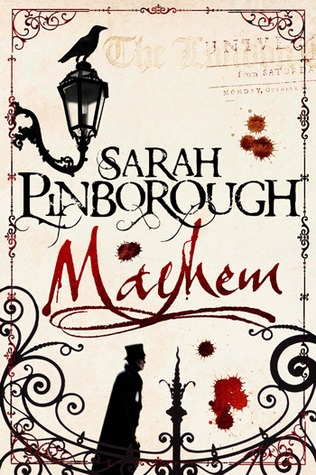
This is the first work by Sarah Pinborough I've read and while I can't say I hated the book, when I finished it I was left feeling as though something was missing from the story. It felt, I don't know, lightweight, and I'm not sure why. After all, it was well-researched (from what I could tell) and atmospheric, with a compelling story. Also a unique one. After all, how many out there, aside from hardcore Ripperologists, have heard of the Torso Killer who went on his murderous spree at the same time as Jack? Not me. Granted, I'm not unfamiliar with Jack the Ripper and have spent my fair share of time researching the case and formulating my own theories, but I'd still consider myself far from being a true Ripperologist, so hearing about a second, equally depraved serial killer terrorizing London alongside Jack piqued my curiosity to no end.
I think part, or actually most of the problem, was that the book felt as though it didn't really know what it was trying to be or how it wanted to tell the story. Divided into three parts, part one started out as a pretty straightforward historical thriller/mystery, detailing the initial search for this Torso Killer. Though the multiple P.O.V.s were distracting, the overall tone was one I liked, sort of a Victorian England CSI. The only issue I had with this section is that the story seemed a bit too reminiscent of the movie From Hell, as Pinborough wrote her main character as also being an opium addict. Then part two begins and suddenly a supernatural element, which had been introduced earlier in the form of a refugee from Eastern Europe who has visions of evil things to come, takes over and alters the tone of the story. Not only that, but that supernatural thread never feels quite right, like a skin of oil resting on top of a glass of water: it's there, but it doesn't mix in. In part three, the author is trying to tie everything together and wind the story up, and as a result things seems to drag on just a bit too long until all of a sudden, we're at the finale of the book and... it's just over with. It came off as being anticlimactic: there was a fight with the villain that was over and done with quite quickly, and the whole situation just tied itself up all neat and pretty. I didn't feel satisfied with how things worked out, like the payoff just wasn't great enough for all the trauma the characters went through up to that point. There was also supposed to be a twist, but once you put the pieces together, you could see that "twist" coming from a mile away. It didn't help that the story's multiple P.O.V.s, which can sometimes be a tricky proposition, made it quite difficult to settle into the story: as soon as I was drawn into following the story from one character's perspective, the chapter ended and another voice took over.
Which is a real shame because, at its heart, Mayhem is a well-written book. Let down by the occasional spelling mistake, some odd grammar choices, and other style quirks, sadly, leading me to feel not entirely pleased with the novel. And while the subject matter itself was compelling enough to keep me reading, I wish Pinborough had stuck to using a strictly psychological thriller angle to explore the mystery of the Torso Killer.
Read from January 19-26, 2014
Reviewed for the Amazon Vine Program March 10, 2014
Sunday, November 3, 2013
How can so much awesomeness exist in one little book? How?

5 out of 5 stars
Okay, I really hate Ann Aguirre. I am dead serious here. She writes the best action-adventure/sci-fi/fiction/YA of anyone out there today. To the point where I could literally swallow my tongue out of jealousy whenever I read one of her books. Hyperbole? Nope, not even close.
Horde is the final book in Aguirre's Razorland Trilogy , and what a finale it is! If Enclave was the skeleton and Outpost was the muscles and organs, Horde is the tattooed, punk-ass skin on this most awesome literary creation. Horde begins where Outpost left off: the town of Salvation is under siege by Freaks, the remnants of humanity gone savage, and in order to save the place they've come to love and call home, Deuce, Fade, Stalker, and Tegan must leave their families behind in order to find help in one of the surrounding settlements. But this is no mere rescue mission. Because things have changed. The Freaks are no longer just the mindless beasts they once were; they've become more cunning and resourceful, and in order to save her family and free humans from the threat of these mutants, Deuce will learn to lead an army which has forgotten how to fight. This war isn't just for the sake of her family or the families in Salvation, however. This is a war to save the entire human race, a war that must be won at all costs, and that's a burden Deuce might not be able to carry.
When I started reading this book, I promised myself that I would try to take it as slow as possible, in order to savor it, but I couldn't help myself. Aguirre throws you right into the action and makes it impossible to slow down. Which is probably why I stayed up until 6 a.m. the day I finished reading this. Even as I reached the end and was satisfied every step of the way, I mentally cried because I just did not want the story to end. (I might've also physically cried a little bit as well.) Deuce has been such a fascinating, deep, and rich character from beginning to end, and part of that comes from Ann's writing in that she's allowed Deuce to grow and to change as she learns more about herself as well as the people and world around her. Yet Deuce isn't alone; the supporting characters are all real and tangible individuals, making us care for them even as Ann plays with their “lives,” even going so far as killing someone off in a scene you'll never see coming. The bitch. And I mean that in the best way because it's only the bravest author who'll let a character die in service of the story, regardless of how much an audience might care for that character. With this novel, Deuce, already having come so far from where she started, has to keep fighting uphill battles every step of the way and Aguirre lets us see her weariness, lets us see when Deuce reaches her breaking point and very nearly snaps, feel her terror, her hopelessness, her confusion and despair. And yet she keeps moving, planting one foot in front of the other and in the end manages to come out of such blackness carrying victory on her shoulders. It's a journey that'll wring you out in so many ways, but is so fulfilling you'll want to cheer.
I have a feeling it's only the easily parsable books that are made into movies, those books that can be broken down into tropes and cliches and easily understood themes so that the dollar sign-eyed movie studio execs do a little dance for joy in anticipation of all the money they'll make off a new tentpole franchise.* Take, for example, The Hunger Games. Don't get me wrong, I read the first book and thoroughly enjoyed it as it's a well-written book. But, the thing is, The Hunger Games is also part of a trilogy, yet as much as I thought the first book was fabulous, I still have not read the other two. With the Razorland Trilogy , I couldn't not read each entry in the series even if I tried. The only way would've been to have physically stopped me, because I had to, I just had to find out what happened next. What trouble would next find Deuce, what would become of her relationship with Fade and Stalker, what Tegan would do to find her courage and place in the world. And those things may sound like issues common to any other YA book or series of recent publication, but with Aguirre's writing, there's always a little something extra, a different take or new angle on the situation. There's always more to the story. Out of the YA trilogies that have lately been made into movies or are in the process of being made, of none of them have I read beyond the first book, no matter how good that first book might've been. Though it may sound mean and counterintuitive, I really hope no movie producer or production company purchases the rights to the Razorland Trilogy , because no-one, no script writer, no director, no studio, could do it justice. Bold claim, perhaps, but just read the books and ask yourself if I'm exaggerating.
I'm not sure any of this is coming out intelligibly and I know I probably sound like some kind of squeeing fan girl. You know what, though? I totally am that squeeing fan girl and proud of it. Taut, tight, well-crafted, and often heartbreaking, her books have totally become my book candy, those titles I hoard miser-style, savor even as I speed through the pages, and turn to whenever I need a comforting pick-me-up.
*I had to edit my previous remarks to be a bit less inflammatory. You'll have to excuse them, and me, as when I wrote this review, I was coming off a major "OMG! I've just read the most awesome book in the world, finishing up the most awesome trilogy in the world!" high. In that kind of situation, enthusiasm overrules any restraint or common sense a person might possess, hence the rather bombastic nature of what I'd written. That said, I realize I'm still courting controversy and anger from others with what I've said in my review; however, I stand by my remarks and opinions.
Read October 28-November 1, 2013
Reviewed for the Amazon Vine Program November 4, 2013
Truly, anyone can now bake fresh bread at home!
5 out of 5 starsI am an avid at-home baker, especially when it comes to bread. (It's my one weakness, which is why I could never do the bread-free diet.) However, I've always stuck to quick breads because I've been intimidated by the thought of working with yeast. All that kneading and resting and proofing, not to mention the pitfalls to avoid such as overworking the dough, not using fresh yeast, and turning out an end product that's heavy and hard and far away from the fluffy, fresh bread it's supposed to be. So, yeah, because I'm a chicken, I've stuck with quick bread. The New Artisan Bread in Five Minutes a Day takes away all those fears--it is truly a revolution.
Firstly, there's an in-depth overview of equipment and tips & techniques which not only answers a lot of questions about the bread-making process, but also gives you a lot of choices in how you actually go about making bread so you can use or adapt one of those techniques to your specific needs (and budget). The instructions themselves are clearly written and easy to follow, literally foolproof, with measurements given in both volume and weight. (Even though professional bakers know that you get better results using weight measurements of ingredients, novice bakers often prefer going with volume measurements--cups, teaspoons, etc.--as they are familiar and perhaps not as intimidating as working with a scale and tare button. If they even have a kitchen scale, that is, which many don't--like me.) The best part is how hands-off the directions are. I mean, literally, you mix up the dough, cover, let it rest, and then refrigerate. Then when you're ready to bake a loaf, you pull out a piece, shape it, and bake. Poof! You've got fresh bread, just like that! Almost no muss and no fuss.
I can't say I'll ever become an expert or even a fully confident yeast bread baker, but with this book, I'm coming closer to that point. I no longer feel intimidated by the bread-baking process and with the many master recipes and variations given in The New Artisan Bread in Five Minutes a Day, I have a feeling I'll never run out of ideas. I may even get to the point of feeling confident enough in my skills to come up with my own variations.
Read October 3-24, 2013
Reviewed November 3, 2013
For fans of good, classic food (and, perhaps, Phryne Fisher).
5 out of 5 starsI came to this cookbook by way of the Phryne Fisher series of mysteries by Kerry Greenwood. In those books, one of Phryne's adopted daughters, Ruth, wishes to be a cook and the family's cook, Mrs. Butler, recommends The Gentle Art of Cookery as the best source for beginners. And as she's generally known to be, Mrs. Butler (not to mention Kerry Greenwood) was right.
The Gentle Art of Cookery was originally published in 1925 and presents seemingly complicated, French-flavored recipes in straightforward, plain, and easy to follow English, allowing you to create such dishes as Filets de Boeuf à la Carlsbad, Herrings à la Bohemienne, Épinards au Sucre, Navets Glacés, and Mousse au Café without having a dépression nerveuse (mental breakdown) over long-winded and complicated directions. Recipes are arranged by ingredient (Vegetables, Fish, Meat, etc.) and then broken down alphabetically according to the specific type of ingredient (beans, beetroot, cabbage, carrots, etc.), with some ingredients like Chestnuts and Mushrooms getting a chapter all to themselves. Then there are specific chapters devoted to specialty cooking; for example, there's a chapter devoted to Dishes from The Arabian Nights, Home-made Wines and Cups, Flower Recipes, and even Cooking for Children.
This edition is part of a series of reprinted classic cookbooks put out by Quadrille Publishing Limited and I, for one, am grateful Quadrille is reprinting these lovely books and hope they give us more. Not only are they a fun and quite readable glimpse into the past, they reintroduce us to classic dishes that have either been forgotten or put aside as being too fussy and fusty. This new edition is a lovely hardcover, with a sturdy sewn binding, allowing the book to be fully opened to any page. Not only that, but you can be confident of opening the book to the same page repeatedly without worrying over the binding coming apart as it would had it been simply glued. There's a silver satin ribbon bookmark to help you keep your place, and the pages are a slight off-white color with a clear typeface which reduces eye strain considerably. I don't know what the original edition of The Gentle Art of Cookery looked like, but what Quadrille Publishing Ltd. has created here is almost an exact duplicate of a book you might've seen being published a century ago. High-quality and hard-wearing, this is a book destined to become a family heirloom, one of those cookbooks read by young and old alike as its pages are turned, folded over, and dog-eared, and favorite recipes are starred, dripped on, modified, and drooled over. Just like Ruth, you might even keep this cookbook on your bedside table, to read at night and send you into delicious, food-centered dreams.
Read October 20-24, 2013
Reviewed November 13, 2013
Illuminating and well-researched, but ultimately didn't do much for me.
3 out of 5 stars
I'll be honest. I have very little interest in the English monarchs of the Stuart period. I'm more interested in those that came before, the Tudors, and those that came after, the Georgians. The most I knew of Queen Anne was that she was the daughter of James II, and so got caught in the middle of the Catholic/Protestant tug-of-war; she was the sister of Queen Mary, whose husband, William of Orange, invaded the country and bloodlessly took the throne from James; she had multiple (and I do mean multiple) pregnancies, with most of them ending in stillbirths or miscarriages; and she gave her name to a style of furniture and architecture. That's about it. Well, after reading Anne Somerset's biography of Queen Anne, I can say I know more about the woman, but dislike her more and care about her even less than I did before.
According to the book's blurbs, Somerset's work is supposed to have redeemed Anne's name, yet I can't see how. Yes, Somerset definitely presents the most sympathetic view of the woman and, granted, Anne had a difficult life. Caught between a father and political advisers who each wanted to use her to their own ends, not to mention warring religious factions, and Anne's conflicting desires to be a good mother and wife while also being a just and effective queen, hers wasn't the easiest row to hoe. Especially since she lacked any sort of proper education and suffered from multiple health issues her entire life. Yet, to my mind, Anne's biggest handicap was her own personality. She was a possessive, neurotic, jealous, needy, paranoid mess of a woman, with an almost insane desire to control everyone in her life, including her friends, to the point of dictating who they could be friends with. Sadly, those traits dominate and overshadow any of Anne's other accomplishments, even her greatest one of creating a united Britain, making her a thoroughly despicable and unlikeable personage.
This is not a quick or light read, mostly because Somerset also gives in-depth coverage to the political maneuverings of the time, and I do mean in-depth, to the point where it felt like my eyes would cross from all the information flying at me. Lord Something-or-other plotted this, Duke Important-so-and-so objected and introduced such-and-such motion in Parliament, and so on. Don't get me wrong, knowledge of the politics of the time is important, but it just seemed to go on a bit too long. This dryness combined with Anne's petulant and unimaginative personality made for an occasionally dull and lifeless read.
Somerset is an absurdly thorough biographer, making this book probably the most trustworthy and authoritative portrayal of Anne. In the end, however, I also found it to be a rather dull and tedious portrayal as well, never lifting Anne above the historical footnote I always took her for.
Read October 1-November 3, 2013
Reviewed for the Amazon Vine Program November 3, 2013
Subscribe to:
Posts (Atom)