Pages

Tuesday, June 2, 2015

"Once Star received his power, the herds of Anok wouldn't be able to control him, and he realized that was the source of their fear."

Reading this made my inner child (who often escapes and runs amok as an outer child, but that's an issue to deal with another day) gleefully, squealingly happy. About the only thing that would've made the whole thing even better would've been the presence of unicorns. But that's just my horse-obsessed inner child speaking.

The story revolves around a very familiar theme, that of loneliness and not belonging and wondering if everyone would be better off if you just ran away. Believe me, as a teenager, I ran the gamut of these emotions, so I could fully empathize with Star, the protagonist of the story. As a black pegasus in a world where black pegasi aren't an everyday occurrence, Star feels like an outcast. Add in an ancient prophecy attached to those rare black pegasi, one of which is born every hundred years, which states that the pegasus foal will either unite or destroy the herds and become the most powerful pegasus in the land, and it's no wonder Star is either shunned or actively bullied by the other foals, not to mention many of the adult pegasi. As a final insult, Star doesn't fully belong to his herd: His mother had been driven away from her herd and was taken in by the Sun Herd, then died after giving birth to Star; the lead mare, Silvercloud, promised Star's mother she'd protect him, a promise she's kept all these years, to the detriment of her relationship with the herd's over-stallion, Thunderwing. So not only is Star concerned about his destiny, he feels guilty for destroying the lives of those protecting him. This makes for one sad, lonely little youngster. The fact that, on top of all these issues, Star is a pegasus who can't fly . . . Well, it's no wonder he feels depressed! In the end, Star comes through his trauma and finds his place in the world, but it's a bumpy road he has to travel before reaching that peak.

This is definitely not a light and fluffy book, an impression one might get upon hearing that it's all about pretty, pretty pegasi. But right from the start, in the first chapter, we deal with bullying and fear and the threat of death. From there the book gives us fighting between herds and even within the herd--fighting that ends in a lot of death--more bullying, physical violence, betrayal and vengeance, near-death experiences due to starvation and infection, a forest fire that kills yet more pegasi . . . you get the picture. But don't be put off and think it's too dark for a kid. Trust me, at heart kids are sociopaths, and I mean that in the most positive way: They're still forming their moral compass and books that show how things can go wrong, how life isn't always fair, but how things like love, compassion, cooperation, and sacrifice can save the day provide helpful guidance. Kids are plastic, elastic, and flexible; they can handle more serious issues that we adults might want to shield them from. But exposure to the darker side of life, even viewed through the lens of fantasy, gives kids a more well-rounded attitude and the potential to cope with any future issues that might befall them. They'll sympathize with Star and root for him even as they growl at Star's enemies, especially Brackentail; they'll cry when things go wrong and yelp for joy when Star finally starts to fulfill his destiny. In short, I can see both girls and boys devouring this book and any follow-up volumes.

I've noticed some people dinging the bit where Star's tears cause flowers to spring up in their wake, complaining it's too far-fetched and silly. Um, we're talking about a book concerning talking pegasi and a star on a hundred-year cycle that gives one particular pegasus a unique power. You're going to complain about the idea of flowers growing from tears? *opens mouth, pauses, shuts mouth and shakes head* Yes, Star's tears bring forth flowers, which I took as an obvious and overt sign that his destiny isn't written by an ancient prophecy. Star's destiny is one he will write every day, one of his own making. A destiny I'm eager to read about in however many sequels Ms. Alvarez decides to write (very, very many, I'm hoping).


Read from June 1 to June 2, 2015
Reviewed June 3, 2015

Saturday, May 16, 2015

Austin has always been an offbeat city... with this book, you now know why.

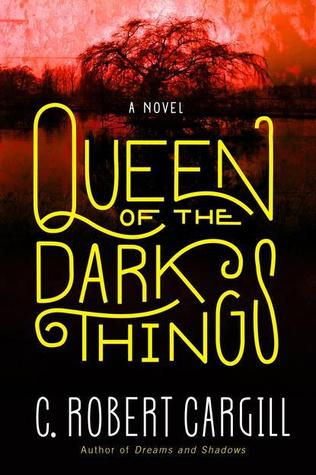
With Queen of the Dark Things, C. Robert Cargill returns to the dark, consequence-filled world he created in Dreams and Shadows. This time around, his modern fairytale comes wrapped in the mythology of the Australian aboriginal people, creating a more philosophical and, if possible, even darker story than his previous book as the themes of life, death, and the afterlife are explored.

I was actually rather surprised when I saw this book, as I'd read the first one with the understanding that it was a stand-alone novel. So with my surprise came the tiniest bit of dread. After all, Cargill's debut, Dreams & Shadows, was so dark and twisted and unique--would any kind of follow-up be able to match the level of creativity he'd created, let alone surpass it? Well, in my highly personal opinion, I feel I can say: Yes, yes it can.

Our story begins on a island somewhere in the Indian Sea in the year 1629, where the remnants of the shipwrecked Batavia have created a gallows for the small company of sailors, led by one Jeronimus Cornelisz, who mutinied. Handless and lifeless, these mutineers return as ghosts to seek vengeance on their fellow conspirators, the ones who survived the gallows by turning on their mates. No matter how long it takes. From there we return to the present, to Austin, TX and to Colby. It's been a few months since the showdown at the end of Dreams & Shadows and he's still mourning the loss of pretty much everything, especially his best friend, Ewan. This grief takes the form of severe self-recrimination and self-destruction. But Colby won't be allowed to spiral down: his actions have made him famous (or infamous, depending on who you ask) and brought a lot of people out of the woodwork. Including some very dangerous enemies looking to settle a score. Into this dark and treacherous world is thrown Kaycee, a young girl from Australia, who is the yang to Colby's yin and has some very special abilities of her own. They're drawn together, and with the aid of the djinn Yashar, the Clever Man Mandu, Gossamer the talking golden retriever, and others--not all of them willing allies--attempt to hold back the evil threatening to spill out of the land of dreams and into our world.

From demons and djinn, to ghosts and fairies and the personification of Austin in the form of a woman, Cargill somehow manages to throw together disparate mythologies and cultures into a story that is cinematic in scope (no surprise, really, considering he's a screenwriter) yet still intimate enough to make the reader involved in the characters' lives and emotional journey. As with his previous book, Cargill also intersperses chapters from scholarly works, in this case works by a "Dr. Thaddeus Ray, Ph.D." concerning the history and significance of the Aboriginal concept of Dreamwalking and the role of the Clever Men who straddle the line between our world and the Dreamtime, along with other "references" which tie into and deepen both the chapters that follow these side excursions as well as the story as a whole. The intertwining of these "scholastic" works grounds the story and adds an element of realism, setting Cargill's work apart from most Urban Fantasy. And I say that as a lover of UF. But whereas most UF is set in our world, is meant to be our world with the same set of rules just slightly tweaked by the addition of vampires, werewolves, elves, whathaveyou, you understand that none of it could ever happen. Cargill's storytelling, however, leaves a small nugget of doubt in your mind telling you that, should you turn the wrong corner at just the right time, in the right city, you might just run into something straight out of your worst nightmare.

Read from May 10-June 1, 2014
Reviewed for the Amazon Vine Program May 17, 2015

If you've ever wanted to walk in the footsteps of Charles Dickens, read this book and you will.

With this exhaustively researched tome, Judith Flanders has managed to plop the reader down in pre-Victorian London (despite what the title says; the author explains the discrepancy in her author's note) and give them a front-row seat to all the changes that occurred to that marvelous metropolis during the period in which Charles Dickens lived and wrote. Changes Dickens witnessed firsthand as he roamed the streets, memorizing every cobblestone, every inch of macadam, every plank of wood and concrete paver in his path. The man was famous for his intimate knowledge of the roads beneath his boots: It was said you could set him down on any corner in London and he could tell you the exact location using the encyclopedia of smells, sounds, and textures he'd gathered through his daily walks. Using not just his life but excerpts of his works, Flanders presents to us the city Dickens loved and lived in as well as the city as he hoped it could be.

Much like Ancient Rome, Londoners of this period spent most of their time outside the home either from desire or necessity, doing their cooking, eating, washing, working, playing, and even dying on the variously paved streets of the city. With the two-pronged approach of showing us London through Dickens' reality and his fiction, we are exposed to the cruel dichotomy created by the cheek-by-jowl nature of businessmen walking to work on streets on which prostitutes plied their trade; indigent or immigrant children playing games on streets strewn with mounds of horse droppings, raw sewage, even the bodies of dead animals; grand, stately townhomes surrounding quiet squares lined with trees and gardens sitting at the back of overcrowded, underfunded slums and tenements where the residents lived, worked, and died crowded by the dozens into shoebox-sized rooms.

I visited London back in 1997 and didn't spend nearly enough time there--I certainly didn't see all I wished to see. Reading The Victorian City makes me wish I had the ability to travel back to London and walk the streets Dickens knew. Since that's unlikely, the vivid sights, sounds, and smells Flanders presents in her book will have to suffice. If you're a Dickens fan or a fan of British or socioeconomic history, or simply a fan of a well-written, finely composed work of non-fiction, then this is the book you need to read.

Read from June 1-July 20, 2014
Reviewed for the Amazon Vine Program May 16, 2015

Thursday, May 14, 2015

"Good Lord, Maisie Dobbs, where do you think you are going with those books?"

3.5 stars

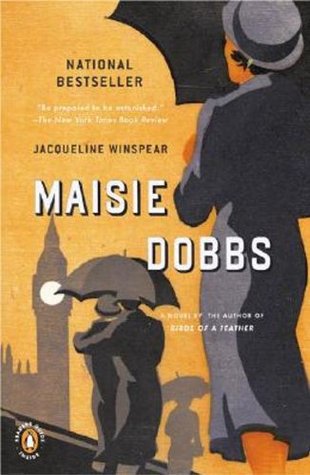
As often happens with novels I rate at 3.5 stars, I have mixed feelings about what I've read. On the one hand, the book as a whole was an easy read. The story moved at a quick clip--I never felt a drag in what was actually being told, regardless of how it pertained to the plot--the dialogue is crisp, and the story was entertaining. Yet, despite how entertaining the book was, it felt slightly misleading.

We start with young Maisie Dobbs as she opens up a detective agency and receives her first big case. Maisie, a young lady who was trained by a Hercule Poirot-type mentor and sponsored by a bored but socially-conscious aristocrat, treks through 1929 London to figure out if her client's wife is cheating on him, and in doing so discovers an even larger mystery involving the real "Walking Dead", those soldiers who returned from the Great War disfigured in more than just body. It took a while for the "mystery" of this mystery novel to finally unfold, and when it did, it was slightly disappointing. Anyone familiar with even the basic tenets and M.O. of a cult would've seen the denouement coming from a mile away. Not only that, but shortly into Maisie's investigation of this "mystery", the novel shifts and we spend time in Maisie's past where we discover how she came to the attention of her mentor and sponsor, and how the Great War shaped and affected her. Now, contrary to some, I like a good backstory: I like seeing where a character comes from, how they came to be who they are and discover their raison d'etre. And I understand why Winspear gives us that insight into Maisie--it allows us to understand a bit better how Maisie relates to the surviving soldiers she needs to deal with. The way Winspear did it, though, seems a bit clumsy and disruptive to the main plotline; with the mystery at the heart of the novel being so weak, it seems it would've profited from a direct telling rather than the interrupted one it got.

I also got the overwhelming sense of something "Mary Sue" about the whole book, not just the protagonist; every character was just so . . . nice. There's nothing wrong with nice, don't get me wrong, but even the villain wasn't bad per se, just thoroughly destroyed mentally by the terrors he'd gone through in the first World War. The few people that Maisie didn't "rub along with" were never out-and-out mean to her; any antagonism sprang from the other person's anger/disappointment/fear of something happening in their life, not from any personal dislike of Maisie herself. And the other characters in Maisie's life were overwhelmingly supportive of her, willing to cross any social/financial boundaries in order to assist her. Which is just so wildly unrealistic. I admit, I'm the "glass half empty" type of person. (Actually, I'm the "the glass is half empty because the glass is cracked and leaking and will cut me if I pick it up" type person.) So I have a natural aversion to anything too perky or sweet. But to have a good story is to have friction and drama, which only comes when things don't go easy: when people are mean to you, maybe for no good reason, maybe for every reason; when things are hard and no help is forthcoming from those who could ease the way, making the struggle that much more of an uphill battle. A life in which things go too easy, where everyone is on your character's side and they get all the help they need or want from those around them, has the potential to be a rather boring story.

From the author's notes and mini interview at the back of the book, the main theme of Maisie Dobbs was a personal one based on Winspear's curiosity of WWI-era Britain as well as family history/stories of that time period. Considering the violence and social upheaval the first world war engendered, perhaps Winspear didn't want to add any fictional conflict from the actions of her characters. Maybe she wanted to present a more idealized image of the ordinary citizen to counteract all that violence. Who knows. It just seems to do a disservice to the reader in my opinion. After all, even in the midst of chaos, life goes on: Good people still do good deeds, evil people still do evil deeds, and most people reside somewhere in between as they work their way through life. That's where your conflict comes from. And that's where the stories come from.

Read from May 11-14, 2015
Reviewed May 15, 2015

Wednesday, March 19, 2014

“'By all the gods, 'Hotep, is [Akenaten] mad?' I asked... ...'Oh, yes,' he whispered into my shoulder. 'He is quite mad.'”

4 out of 5 stars

As it's been a while (a long while!) since I read this book, I don't think I'll be able to turn my notes into a coherent, "traditional" review, so I'll just post them here as-is.

-Like other reviewers have pointed out, the continued use of “the phallus” got old very quickly. After the first use, in fact. And, for me, it wasn't necessarily the use of the word 'phallus' that bothered me, though it was annoying enough; no, it was the fact that it was always referred to as “the phallus.” Greenwood slipped up one time and wrote “my phallus,” and, oh boy, I had a hearty chuckle over that.
--Once again, Nefertiti is portrayed as being beautiful yet stupid. I mean, I guess I can see that as one explanation as to why she goes along with Akenaten's new religion—Greenwood writes Nefertiti as extremely biddable and easily placated, as someone who won't be dissuaded from a path of action once she's fixed on it, no matter how much anyone argues with her to the contrary—I'm just getting tired of people writing beautiful women as also being stupid. Haven't there been many beautiful women, both famous, infamous, and ordinary, over the centuries who have been twice-cursed with both brains and beauty? Why not Nefertiti as well? I guess I'd just like to see her written as being rather canny, perhaps as a woman who used Akenaten for her purposes rather than simply bowed to his. Maybe I'm just daydreaming.
--I am not a lettered or professional historian or Egyptologist; I'm more what you would call an “armchair” expert. So I can't comment on the research Greenwood has done in order to write this book, though, to my eyes, it looks comprehensive enough. And some of the hypotheses she's used in her story seem perfectly reasonable, especially as regards to Akenaten's personality. After all, Akenaten was a cult leader, probably one of the first. He managed to convince an entire country, willing or not, to abandon their belief system in favor of a god, the Aten, he may not have necessarily created but certainly limned in the image decreed by Akenaten. Because of this high-handed approach, Akenaten, as described by Greenwood, is dreamy, unfocused, unconcerned with day-to-day problems, yet also completely ruthless, megalomaniacal, deluded as well as delusional, and completely willing to sacrifice anyone in the service of his religion and his goals for the Aten. The Amarna period is a fascinating one and ripe for all sorts of exploration and deconstruction by novelists. It's also quite vulnerable to revision, which makes the version presented by Greenwood the most realistic, even probable.
--I think the main problem I had with the book, apart from it not being a mystery despite what it says on the cover (which I really can't figure out, unless they're talking about the mystery of Amarna and the goings-on of Akenaten et al, but even that seems rather senseless). What was I saying? Oh, yes, the main problem I had with the book is that it seemed as though it couldn't decide whether to be a dynamic tale of two people set in the court of Akenaten or an expanded version of one of those “What Life was Like...” books, where the daily activities of the Amarna period are brought to life by showing a couple of characters, real or fictional, acting them out. The story itself was compelling, at its heart, that of two people, Mutnodjme, half-sister to Nefertiti, and Ptah-Hotep, Great Royal Scribe, who get caught up in the center of the whirlwind changes instigated by Akenaten, from their beginnings to the bitter end. The story alternates between those two P.O.V.s, which is fine. However, where the “What Life was Like...” aspect came in was with the insertion of almost tedious asides, such as the numerous poems and songs and fables and parables recited by one character or another for the edification of some other character and, by extension, the reader. After the first couple of these recitations, which didn't seem to have any bearing on the actual plot, I started skimming over the others whenever they appeared, which was quite frequently. It's not that I have anything against reading ancient Egyptian literature; quite the contrary, in fact. I just didn't see the point of inserting so many examples of their writing into the novel. Yes, when the characters quoted something wise or on point in regards to the action of the moment, those were relevant, but the others simply felt like an excuse for Greenwood to share some of her research with us.
--It was hilarious at the end of the book: Someone forgot to put the end tag to some italic text (yet another piece of Egyptian writing, this time an edict by Horemheb, concerning his right to the throne), meaning that the last two and a half pages of the book were italicized. This has been the poorliest (that's a word, right?) edited book of Greenwood's put out by Poison Pen Press that I've ever read. The constant italics were the worst error, but I saw many others as I read, usually having to do with punctuation. Was PPP in that much of a rush to publish this book that they could've have taken a bit more time to make sure it was a bit better edited? Seems sloppy to me.
--Yet the more I think about the book and remember the story, the more I like it, in spite of its problems and idiosyncrasies. It's a vivid, entertaining, richly detailed (and I do mean detailed) look at a period of ancient Egyptian history that, yes, has been covered quite extensively in the past. But because the Amarna period is a lively enough nonfiction subject, there's enough scope and depth to mine for inspiration, and the mysteries that come along with the facts provide ample fodder for intelligently hypothesized solutions to those mysteries. Thankfully, Kerry Greenwood is an intelligent and competent enough writer to tackle those mysteries and do them some justice.

Read from August 15-20, 2013
Reviewed March 19, 2014

Though the subject matter was interesting, the telling of it was only so-so.

3 out of 5 stars

“Compulsively readable.” You see that quite frequently in front cover (or back cover, whichever) blurbs, but what exactly does that mean? And can it really apply to so many books? Well, I can't answer for the second question, but as to the first, I would say the phrase describes something that can't be put down; a book that one keeps reading well into the wee hours of the night, perhaps even until the first rays of dawn peek through the windows. If the “compulsively readable” phrase gets tossed around too much until it loses some of its punch, in the case of Harold Schechter's The Mad Sculptor it is thoroughly deserved and 100% true.

And yet...

After a while, the story begins to slow down, especially when it comes to the detailing of Robet Irwin's, The Mad Sculptor himself, many stints in mental institutions and his movements in between those stints. The whole thing becomes so tedious after a while, you begin to wonder exactly what kind of story Schechter is trying to tell. Especially when he includes the stories behind the many murders that occurred in the same Beekman Place neighborhood as where Irwin killed Veronica Gedeon. Don't get me wrong, I enjoyed those side excursions, but to me all it did was muddle the direction of the book. When I reached the end, I wondered what exactly was the point. If Schechter wanted to explore the strange history of Beekman Place and why so many murders occurred in such a short period of time in the early part of the 20th century--was the neighborhood cursed? Did it have anything to do with the deprivations of the Great Depression? etc.--which I would've found interesting, then why focus so much on Irwin? If Schechter wanted to explore the psychopathy of Irwin, why did he peel off so many times to focus on those other murders, in which Irwin wasn't involved? It just came off as messy and uneven. Which is strange because I've read several of Schechter's other true crime books and have always found him to be both informative and entertaining, with a very readable narrative. Certainly nothing like what I encountered in The Mad Sculptor.

Read from January 26-February 1, 2014
Reviewed for the Amazon Vine Program March 19, 2014

"The neglected Infanta was about to become the most courted woman in England, the Queen, the bride of the most handsome, the most kingly ruler in Christendom."


2.5 out of 5 stars

If I'd read this compilation (or the individual novels) about twenty years ago, before I'd studied and read so much concerning Tudor history, I probably would've enjoyed it more. As it is, I just know too much and have too many suppositions and theories of my own; whenever I came upon points of contention, I would say to myself, "Ah, so she went with this version of that event. Okay, so she used this birth date rather than the later one." And so on. So while I can appreciate that Plaidy was an excellent author insofar as creating believable characters and a compelling narrative, her biases ruined the overall experience as they made for rather one-sided characters, especially when it came to Henry VIII. Yes, he was a bastard, there's no doubt about that, but Plaidy's version was almost a caricature--his behavior and personality was just so over-the-top, it was cartoonish. And of course Plaidy went with the standard (at the time) portrayal of "mad" Juana, Katharine's sister, a woman whose image was thoroughly tarnished and maligned by those who purported to love her, who is now becoming somewhat rehabilitated.  Not to mention Plaidy had a habit of repeating either information (in what is probably one of the earliest examples of the "As you know, Bob" exposition, I'm guessing), dialogue, or, the most egregious, descriptions. I stopped counting after about the tenth use of "piggy" to describe Henry's eyes. In a way, I believe Jean Plaidy was the Philippa Gregory of her time: she was able to introduce many exciting historical eras and personages to readers using what reference materials were available to her, for which she deserves the lauds she receives, but it's quite obvious she infused her novels with biases and suppositions, possibly her own, possibly those of the sources on which she relied. Either way, while it makes for an entertaining read for those not in the know, for those in the know, reading her books can be disappointing and frustrating, which overwhelms their entertainment value.

Read from February 17-March 17, 2014
Reviewed March 17, 2014