Pages

Sunday, November 3, 2013

How can so much awesomeness exist in one little book? How?


5 out of 5 stars

Okay, I really hate Ann Aguirre. I am dead serious here. She writes the best action-adventure/sci-fi/fiction/YA of anyone out there today. To the point where I could literally swallow my tongue out of jealousy whenever I read one of her books. Hyperbole? Nope, not even close.

Horde is the final book in Aguirre's Razorland Trilogy , and what a finale it is! If Enclave was the skeleton and Outpost was the muscles and organs, Horde is the tattooed, punk-ass skin on this most awesome literary creation. Horde begins where Outpost left off: the town of Salvation is under siege by Freaks, the remnants of humanity gone savage, and in order to save the place they've come to love and call home, Deuce, Fade, Stalker, and Tegan must leave their families behind in order to find help in one of the surrounding settlements. But this is no mere rescue mission. Because things have changed. The Freaks are no longer just the mindless beasts they once were; they've become more cunning and resourceful, and in order to save her family and free humans from the threat of these mutants, Deuce will learn to lead an army which has forgotten how to fight. This war isn't just for the sake of her family or the families in Salvation, however. This is a war to save the entire human race, a war that must be won at all costs, and that's a burden Deuce might not be able to carry.

When I started reading this book, I promised myself that I would try to take it as slow as possible, in order to savor it, but I couldn't help myself. Aguirre throws you right into the action and makes it impossible to slow down. Which is probably why I stayed up until 6 a.m. the day I finished reading this. Even as I reached the end and was satisfied every step of the way, I mentally cried because I just did not want the story to end. (I might've also physically cried a little bit as well.) Deuce has been such a fascinating, deep, and rich character from beginning to end, and part of that comes from Ann's writing in that she's allowed Deuce to grow and to change as she learns more about herself as well as the people and world around her. Yet Deuce isn't alone; the supporting characters are all real and tangible individuals, making us care for them even as Ann plays with their “lives,” even going so far as killing someone off in a scene you'll never see coming. The bitch. And I mean that in the best way because it's only the bravest author who'll let a character die in service of the story, regardless of how much an audience might care for that character. With this novel, Deuce, already having come so far from where she started, has to keep fighting uphill battles every step of the way and Aguirre lets us see her weariness, lets us see when Deuce reaches her breaking point and very nearly snaps, feel her terror, her hopelessness, her confusion and despair. And yet she keeps moving, planting one foot in front of the other and in the end manages to come out of such blackness carrying victory on her shoulders. It's a journey that'll wring you out in so many ways, but is so fulfilling you'll want to cheer.

I have a feeling it's only the easily parsable books that are made into movies, those books that can be broken down into tropes and cliches and easily understood themes so that the dollar sign-eyed movie studio execs do a little dance for joy in anticipation of all the money they'll make off a new tentpole franchise.* Take, for example, The Hunger Games. Don't get me wrong, I read the first book and thoroughly enjoyed it as it's a well-written book. But, the thing is, The Hunger Games is also part of a trilogy, yet as much as I thought the first book was fabulous, I still have not read the other two. With the Razorland Trilogy , I couldn't not read each entry in the series even if I tried. The only way would've been to have physically stopped me, because I had to, I just had to find out what happened next. What trouble would next find Deuce, what would become of her relationship with Fade and Stalker, what Tegan would do to find her courage and place in the world. And those things may sound like issues common to any other YA book or series of recent publication, but with Aguirre's writing, there's always a little something extra, a different take or new angle on the situation. There's always more to the story. Out of the YA trilogies that have lately been made into movies or are in the process of being made, of none of them have I read beyond the first book, no matter how good that first book might've been. Though it may sound mean and counterintuitive, I really hope no movie producer or production company purchases the rights to the Razorland Trilogy , because no-one, no script writer, no director, no studio, could do it justice. Bold claim, perhaps, but just read the books and ask yourself if I'm exaggerating.

I'm not sure any of this is coming out intelligibly and I know I probably sound like some kind of squeeing fan girl. You know what, though? I totally am that squeeing fan girl and proud of it. Taut, tight, well-crafted, and often heartbreaking, her books have totally become my book candy, those titles I hoard miser-style, savor even as I speed through the pages, and turn to whenever I need a comforting pick-me-up.

*I had to edit my previous remarks to be a bit less inflammatory. You'll have to excuse them, and me, as when I wrote this review, I was coming off a major "OMG! I've just read the most awesome book in the world, finishing up the most awesome trilogy in the world!" high. In that kind of situation, enthusiasm overrules any restraint or common sense a person might possess, hence the rather bombastic nature of what I'd written. That said, I realize I'm still courting controversy and anger from others with what I've said in my review; however, I stand by my remarks and opinions.        

Read October 28-November 1, 2013
Reviewed for the Amazon Vine Program November 4, 2013

Truly, anyone can now bake fresh bread at home!


5 out of 5 stars

I am an avid at-home baker, especially when it comes to bread. (It's my one weakness, which is why I could never do the bread-free diet.) However, I've always stuck to quick breads because I've been intimidated by the thought of working with yeast. All that kneading and resting and proofing, not to mention the pitfalls to avoid such as overworking the dough, not using fresh yeast, and turning out an end product that's heavy and hard and far away from the fluffy, fresh bread it's supposed to be. So, yeah, because I'm a chicken, I've stuck with quick bread. The New Artisan Bread in Five Minutes a Day takes away all those fears--it is truly a revolution.

Firstly, there's an in-depth overview of equipment and tips & techniques which not only answers a lot of questions about the bread-making process, but also gives you a lot of choices in how you actually go about making bread so you can use or adapt one of those techniques to your specific needs (and budget). The instructions themselves are clearly written and easy to follow, literally foolproof, with measurements given in both volume and weight. (Even though professional bakers know that you get better results using weight measurements of ingredients, novice bakers often prefer going with volume measurements--cups, teaspoons, etc.--as they are familiar and perhaps not as intimidating as working with a scale and tare button. If they even have a kitchen scale, that is, which many don't--like me.) The best part is how hands-off the directions are. I mean, literally, you mix up the dough, cover, let it rest, and then refrigerate. Then when you're ready to bake a loaf, you pull out a piece, shape it, and bake. Poof! You've got fresh bread, just like that! Almost no muss and no fuss.

I can't say I'll ever become an expert or even a fully confident yeast bread baker, but with this book, I'm coming closer to that point. I no longer feel intimidated by the bread-baking process and with the many master recipes and variations given in The New Artisan Bread in Five Minutes a Day, I have a feeling I'll never run out of ideas. I may even get to the point of feeling confident enough in my skills to come up with my own variations.

Read October 3-24, 2013
Reviewed November 3, 2013

For fans of good, classic food (and, perhaps, Phryne Fisher).


5 out of 5 stars

I came to this cookbook by way of the Phryne Fisher series of mysteries by Kerry Greenwood. In those books, one of Phryne's adopted daughters, Ruth, wishes to be a cook and the family's cook, Mrs. Butler, recommends The Gentle Art of Cookery as the best source for beginners. And as she's generally known to be, Mrs. Butler (not to mention Kerry Greenwood) was right.

The Gentle Art of Cookery was originally published in 1925 and presents seemingly complicated, French-flavored recipes in straightforward, plain, and easy to follow English, allowing you to create such dishes as Filets de Boeuf à la Carlsbad, Herrings à la Bohemienne, Épinards au Sucre, Navets Glacés, and Mousse au Café without having a dépression nerveuse (mental breakdown) over long-winded and complicated directions. Recipes are arranged by ingredient (Vegetables, Fish, Meat, etc.) and then broken down alphabetically according to the specific type of ingredient (beans, beetroot, cabbage, carrots, etc.), with some ingredients like Chestnuts and Mushrooms getting a chapter all to themselves. Then there are specific chapters devoted to specialty cooking; for example, there's a chapter devoted to Dishes from The Arabian Nights, Home-made Wines and Cups, Flower Recipes, and even Cooking for Children.

This edition is part of a series of reprinted classic cookbooks put out by Quadrille Publishing Limited and I, for one, am grateful Quadrille is reprinting these lovely books and hope they give us more. Not only are they a fun and quite readable glimpse into the past, they reintroduce us to classic dishes that have either been forgotten or put aside as being too fussy and fusty. This new edition is a lovely hardcover, with a sturdy sewn binding, allowing the book to be fully opened to any page. Not only that, but you can be confident of opening the book to the same page repeatedly without worrying over the binding coming apart as it would had it been simply glued. There's a silver satin ribbon bookmark to help you keep your place, and the pages are a slight off-white color with a clear typeface which reduces eye strain considerably. I don't know what the original edition of The Gentle Art of Cookery looked like, but what Quadrille Publishing Ltd. has created here is almost an exact duplicate of a book you might've seen being published a century ago. High-quality and hard-wearing, this is a book destined to become a family heirloom, one of those cookbooks read by young and old alike as its pages are turned, folded over, and dog-eared, and favorite recipes are starred, dripped on, modified, and drooled over. Just like Ruth, you might even keep this cookbook on your bedside table, to read at night and send you into delicious, food-centered dreams.

Read October 20-24, 2013
Reviewed November 13, 2013    

Illuminating and well-researched, but ultimately didn't do much for me.


3 out of 5 stars

I'll be honest. I have very little interest in the English monarchs of the Stuart period. I'm more interested in those that came before, the Tudors, and those that came after, the Georgians. The most I knew of Queen Anne was that she was the daughter of James II, and so got caught in the middle of the Catholic/Protestant tug-of-war; she was the sister of Queen Mary, whose husband, William of Orange, invaded the country and bloodlessly took the throne from James; she had multiple (and I do mean multiple) pregnancies, with most of them ending in stillbirths or miscarriages; and she gave her name to a style of furniture and architecture. That's about it. Well, after reading Anne Somerset's biography of Queen Anne, I can say I know more about the woman, but dislike her more and care about her even less than I did before.

According to the book's blurbs, Somerset's work is supposed to have redeemed Anne's name, yet I can't see how. Yes, Somerset definitely presents the most sympathetic view of the woman and, granted, Anne had a difficult life. Caught between a father and political advisers who each wanted to use her to their own ends, not to mention warring religious factions, and Anne's conflicting desires to be a good mother and wife while also being a just and effective queen, hers wasn't the easiest row to hoe. Especially since she lacked any sort of proper education and suffered from multiple health issues her entire life. Yet, to my mind, Anne's biggest handicap was her own personality. She was a possessive, neurotic, jealous, needy, paranoid mess of a woman, with an almost insane desire to control everyone in her life, including her friends, to the point of dictating who they could be friends with. Sadly, those traits dominate and overshadow any of Anne's other accomplishments, even her greatest one of creating a united Britain, making her a thoroughly despicable and unlikeable personage.

This is not a quick or light read, mostly because Somerset also gives in-depth coverage to the political maneuverings of the time, and I do mean in-depth, to the point where it felt like my eyes would cross from all the information flying at me. Lord Something-or-other plotted this, Duke Important-so-and-so objected and introduced such-and-such motion in Parliament, and so on. Don't get me wrong, knowledge of the politics of the time is important, but it just seemed to go on a bit too long. This dryness combined with Anne's petulant and unimaginative personality made for an occasionally dull and lifeless read.

Somerset is an absurdly thorough biographer, making this book probably the most trustworthy and authoritative portrayal of Anne. In the end, however, I also found it to be a rather dull and tedious portrayal as well, never lifting Anne above the historical footnote I always took her for.

Read October 1-November 3, 2013
Reviewed for the Amazon Vine Program November 3, 2013

Wednesday, August 21, 2013

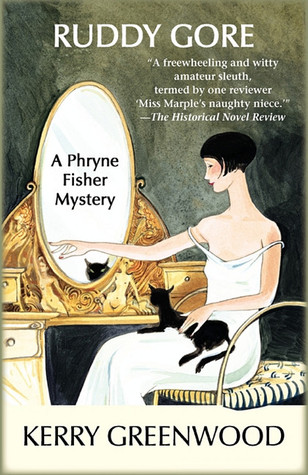
"The hatchet flicked past, end over end, and struck a wooden shutter with a hollow thud... ...'Were you trying to attract my attention?' [Phryne] asked politely."


So begins the seventh entry in the Phryne Fisher mystery series.  After the rather disappointing The Green Mill Murder, Phryne is back on form in Ruddy Gore, this time investigating a murder set in a theater during a performance of Gilbert and Sullivan's Ruddigore. The cast of characters is amusing and diverse, but we're also introduced to someone who sounds as though he'll be sticking around for the next few books, a lovely Chinese man by the name of Lin Chung who becomes Phryne's lover and confidant. I don't think it's necessary for me to go into detail as far as the synopsis; after all, this is a Phryne Fisher mystery. Going in, you know there'll be a mystery in which nothing and no-one is what or who they seem, truths will be uncovered, secrets will be kept by the sphinx-like Phryne as she deems prudent, and Dot will fret. And, as always, there'll be a secondary mystery in addition to the main one which will allow Phryne to fully flex her investigative muscles.


The one thing I noticed (and I can't remember if I ran into this problem in the previous books) is a strange bit of formatting with regards to the dialogue. Several times someone's response would be in the same paragraph, sometimes even the same sentence, as the other person's dialogue, making it confusing as to who was speaking. There were times when I had to reread something a couple of times to differentiate who exactly was doing the talking. Yes, there are times when you can have two people speaking in the same paragraph, usually with some exposition in the middle, which is okay as it usually denotes an immediacy to the conversation. But when it's done repeatedly or, more importantly, when someone's response comes right after the first person's dialogue, and I'm talking about in the same sentence, it makes the exchange unnecessarily confusing and, well, rather sloppy.

Aside from that formatting issue, though, once again I enjoyed becoming immersed in the Australia of the 1920s. Because of my particular peculiarities, I especially enjoyed all the details involving Phryne's (and to a certain extent Dot's) costumes and shoes. I'm a girly-girl that way. Not to mention the descriptions of the meals made by Mrs. Butler or served in the restaurants frequented by Phyrne made my mouth water (and Greenwood mentions food often, meaning I'm constantly slobbering as I read her books) and long for a life where I could have the luxury of snacking on homemade dishes prepared by a skilled cook. Basically, to live like Phryne. And who wouldn't want to live like that?

Read July 22-28, 2013
Reviewed August 21, 2013

Tuesday, June 25, 2013

"The future is not as loud as war, but it is relentless. It has a terrible fury all its own."


Harper Curtis is a killer. He's also an opportunist. On the run from a bunch of thug vigilantes in Depression-era Chicago, he stumbles across a blind woman with a nice coat. Harper wants the coat, but it's what the woman says that sticks in his mind. “Are you Bartek?” As the woman becomes hysterical at his refusal, Harper kills her. And takes the coat as he planned. And finds the key. The key which leads him to the House. Where he finds his Shining Girls and realizes he's been a serial killer all along. You might think this would be the beginning of a rather standard serial killer thriller, if it weren't for the fact that the House also travels through time. It can't go further back in the past beyond the day Harper finds it, nor further into the future beyond 1993, and to no other place but that neighborhood in Chicago, but beyond those limitations, the House can take Harper to any day in any year he desires.

And then there's Kirby, Kirby Mazrachi. One of Harper's victims whom he attacked in 1989 after visiting her in 1974. Who survives and starts hunting him... in 1992. Fun, right? And that's just the beginning of the chase through time for these two. As Harper and Kirby play cat and mouse with each through the years, we see the story play out through various P.O.V.s., and not just those of the main characters. The use of differing P.O.V.s might be off-putting to some, seen as either a too-clever move or a distraction from the story. Instead, these shifting views allow us to get to know these characters intimately, even the one-offs (aka the victims), so that we can see their pain, their desires, their motivations (yes, even for the villain, Harper, despite what some reviewers have said; we get flashbacks to his youth, and we see how he became the monster we see in the novel). In this way, the story unfolds like a budding flower, exquisitely layered while remaining action-packed and swiftly-moving.

Beukes touches on several important moments and issues thanks to the time travel aspect. From issues like the Depression and “Hoovervilles,” to abortions and the Jane Collective (the underground abortion service); from moments in time such as the Radium Girls, the riots of the 1968 Democratic Convention, to the “Rosie the Riveters” of WWII, Beukes brings each of these to life through her character sketches, showing us the living, breathing side of these moments in history, not just what we've seen in books and film strips. And it is these characters that make the novel sing. Even the one-offs, the single-chapter sketches, illuminate living, breathing people. People with flaws and quirks, with dreams and aspirations. People with personalities from every slice of the spectrum. (The character of Alice is simply heart-breaking.) Even the main “heroic” characters of Kirby and Dan (Velasquez, the ex-homicide detective turned sports reporter who Kirby interns for) transcend their potentially cliched roles – plucky ex-victim, world-weary older man/father figure – to become actual human beings. Kirby is plucky, yes, but she's also a pain in the ass: prickly, difficult to deal with, snarky, with a drive that belies her punk exterior and a soft heart. I think what most awes me about Beukes's writing, though, is how utterly despicable she's made Harper. He is the epitome of evil, yet he's no black hat-wearing caricature of a villain. He has dimension. At times in the story, you get the feeling he knows what he's doing is wrong, that perhaps he wants to stop, and is willing to try. But something always pulls him back to murder. Maybe it's the House, maybe it's his inner demons. And the flashback scenes to his childhood are nicely ambiguous. His actions as a child raise questions. Was Harper born evil? Was he destined to become a serial killer? It would've been so easy for Beukes to take the easy way out and write Harper as a simple bad guy. Instead, she makes him just as human as Kirby and the other characters in the book. And that's the mark of a very talented writer.

I've never before read anything written by Lauren Beukes. I've read a sample of one of her previous books, Zoo City, and found it interesting enough to put on my Wish List, but that's it. Now, though, I'll be buying Zoo City ASAP as well as a copy of Moxyland and would suggest that anyone reading this review do the same. Not to sound like some sort of NY Times book review wannabe, but Beukes is most definitely an author to watch.

On a side note: Leonardo DiCaprio's production company, Appian Way, has optioned The Shining Girls and is developing it for television. Now that I've read the book, there's no way they'll ever be able to do the story justice. Nope, sorry, uh-uh, it can't be done. And now I'm sad.

Read June 1-June 7, 2013
Reviewed for the Amazon Vine Program June 25, 2013

Monday, June 10, 2013

"The times change, but the nature of men does not."

 
2.5 out of 5 stars

I really wish I could like this book more than I did. After all, considering the amount of time (ten years!) and effort Michael Ennis put into writing it, to not like seems like a supremely douche-y move on my part. Yet I can't help myself. Now before I break down what it was about the novel which made me dislike it, let me list some things about the book I liked.

First off, those ten years of work clearly shows. This particular period of Italian history hasn't necessarily been brought to life (there's not much focus on anything or anyone beyond that which impacts the plot), but it has been rendered with a depth of detail that creates a passable simulacrum. Part of this might be because all the events used as the backbone of the plot actually occurred; the only fictional bits are the murders and the reactions of the players to those murders. Now, I tend to have mixed feelings about novels which blend real, historically-based figures and/or events with fictional storylines as, frankly, the results can be a mixed-bag, ranging from imaginative to god-awful dreck. It takes real skill to weave a murder-mystery or romance or whatever into an established timeline of events and make that whatever not stick out like a sore thumb. This is a skill Ennis has in spades: He managed to fit a series of gruesome murders seamlessly into an already violent background and make it seem believable that the novel's players, in addition to actions which are on historical record, scampered around the Italian countryside in order to solve those murders. Plus, despite its problems, the story does move along at a nice clip, keeping the reader involved without bogging them down in endless exposition or info dumps.

There's no argument that Ennis is a fine storyteller who is able to create a vivid and compelling tale, and is skilled in the craft of writing. I have no issue with that. If you look at the bare bones of the novel, it's got everything needed to be an engrossing murder-mystery: well-drawn characters (I can say that even while not liking the way they were drawn), action, some gruesome murders, a bit of romance, intrigue, a conspiracy or two, and interesting locations where all this takes place. The problem is, I can't get behind the story Ennis has created or the motivations and characterizations he's given the players, especially after some new research and reading which throws the regurgitated history of the Borgia family right out the window, and (I think) deservedly so. Even without this new information, I still couldn't get behind Ennis's take on Cesare/Valentino's motivations or mental processes, and his depiction of Machiavelli as some sort of love-sick puppy dog who's only motivation seems to be following Damiata around the country so he can crawl back into her bed is grating and a disservice to the real Machiavelli. Even Leonardo da Vinci occasionally came off as more of a caricature: though he's portrayed as eerily prescient about certain technologies and obsessed about discovering the workings of the natural world, which fits in with historical record, there were times when instead he came off more like Doc Brown from the Back to the Future movie franchise. Damiata was the only reasonable, sympathetic voice of the novel and we lose her a third of the way in; the novel starts out with her narrating events in a letter to her son, who is being held captive by Pope Alexander VI until she finds out who murdered Alexander's son, Juan, Duke of Gandia. She ends the letter, believing herself to be near death, and lets Machiavelli pick up the narration, (view spoiler) So my question has to be, why? Why get rid of her as a narrator and use Machiavelli in her place? I understand that Machiavelli is close to both da Vinci and Valentino in the story and, as such, can provide us some insight, I guess, but if it were me, I would've found a way for Damiata to have had a similar closeness in order to keep her as narrator; through her, the story flowed with more action, more intimacy, and more immediacy.

In the end, while I appreciate all the work Ennis put into the novel and can honestly say he's a skilled writer, I just can't agree with the story he put together. Perhaps someone with less knowledge of the Borgias or less interest in a truthful representation of historical figures might, but that's not me.

One minor note: Though others have complained about the Italian sprinkled throughout the book and the lack of translation (which isn't quite accurate as Ennis usually writes the English translation right after the Italian), I didn't have a problem with it. It's not that I speak Italian, and not to be smug, but I took Latin in high school, so it was easy for me to extrapolate what the words meant from their Latin bases.

Read January 6-March 1, 2013
Reviewed for the Amazon Vine Program March 28, 2013