Pages

Tuesday, June 12, 2012

Erudite, Dauntless, Abnegation, Candor, Amity... Which faction are you?

4 out of 5 stars

I feel the need to make this less a review and more a rebuttal towards the many points others have brought up as the reason for why Divergent sucks/doesn't make sense/is lacking:

The book is one big initiation ritual, with the action only taking place in the last 100 pages.

Well, in a way the people saying this are right... and yet they're also wrong. Rather than being a delay to the story, the initiation is the story. Along the way, it's foreshadowed as to what's building up, the big issue which is settled, or starting the process of being settled, at the end of the book. But we need the initiation, the discovery of who Tris is at heart and what she's capable of, to come to fruition before the action could take place. Let me clarify that: Before the action could take place and result in a satisfactory story.

The world-building is lacking insofar as how the factions were created and the reasons why people would go along with the concept.

Okay, so we're never told how the faction system came into being. There's a mention of a 'great peace' after which the factions were formed, so from that we can infer that before that, there was a great war. And it must've been great and devastating and, probably, long, for people to want to divide and segregate themselves in such a manner; not only that, but subjugate their instincts in order to fit into such narrow definitions. Yet, we're human: for all that we say we're individuals and want to go our own way, very few of us actually have the courage to do so. Most follow along with the herd, even those herds who proclaim that they're individuals. Yeah, you're all individuals who are wearing the same thing, doing the same thing, thinking the same thing. Go individuality! As Tris's mom says near the end of the book: “Every faction conditions its members to think and act a certain way. And most people do it. For most people, it's not hard to learn, to find a pattern of thought that works and stay that way.” It's human nature to go with the flow; it's comfortable and it's easy. Just look at the many countries around the world with oppressive governments and little-to-no resistance. So for those critics who say Veronica Roth's five faction system is unrealistic or not well thought out, I say, it's very easy to see humans going along with such a system, even if it is biblically based (which is rather ridiculous and I'll get into the reason for that in a bit).

Why is Abnegation in charge of government when they're such wimps?

Right at the beginning of the book, on page 33, that decision is explained: Representatives from Abnegation make up the ruling council as that faction is seen as incorruptible because of its members commitment to selflessness. So, maybe that's a bit simplistic; after all, wouldn't you want someone from the intelligence or peace faction as well? Wouldn't the faction that prides honesty be just as incorruptible? Possibly. Then again, someone from Candor could be completely honest about how or why he took money as a bribe. So if all you're looking for is a ruling body that won't be swayed by bribes, it makes sense to use a faction that values selflessness above all else. That ruling body may not be particularly politically astute, but it will be inviolable.

Why would this society rely on, let alone trust, a military unit, Dauntless, which is basically made up of psychopaths?

Again, this is explained in the book. Dauntless was once a faction of brave individuals who followed the manifesto set out by its creators, one of lines of which reads: 'We believe in ordinary acts of bravery, in the courage that drives one person to stand up for another.' But recently the leadership of Dauntless changed hands and those that are now in charge emphasis a more ruthless and, yes, slightly psychotic edge to the training and behavior of Dauntless members. Not to mention certain of those leaders are in cahoots with Jeanine, the big villain of the piece, ***SPOILER***in their search to identify and weed out Divergents like Tris, not to mention start a war in order to overthrow the current government, ***END SPOILER*** which means even more they're going to do things and behave in ways more vicious than previous Dauntless. Basically, the faction is corrupting, which ties in with the increasingly noticeable corruption of the other factions, mainly Erudite and Candor. As a faction corrupts, it changes and it worsens. Which is why the Dauntless seem like nothing more than train-chasing, adrenaline-junky, building-jumping hooligans.

Tris is cold/robotic/lacking in sympathy/judgmental.

There are a lot of facets to this particular complaint. One part complains about Tris's problem with intimacy. I hate to seem like a broken record, but this is explained in the book. By growing up in Abnegation, Tris isn't used to physical contact, from hugs to shaking hands. So it makes sense that, while she and Four could do some innocent petting, the idea of full-on sexual relations with the boy would freak her out and make her pause. Believe me, I completely understand this point: I'm unused to physical contact myself; I'm not a hugger and the one time a strange man touched my shoulder (as a way to apologize for bumping into me, not in any perverted way), I flinched and freaked out internally. Yeah, probably more than you wanted to know about me, but, still, I know whereof Tris is coming from. Anyway, then there's the charge that she's judgmental towards her fellow initiates. Mainly this charge revolves around how she behaves when she hears the other initiate, Al, crying after their first night in Dauntless. Instead of comforting him, as she's been raised to do, she feels disgust that someone who looks so strong should act so weak. Yeah, it sounds pretty heartless, until you realize what she's dealing with: For her entire life she's been told to live only for the good of others, to deny herself in favor of helping others. Yet her instincts are contrary to this; she doesn't want to help others, at least not to the detriment of herself. If she helps Al, she's just reinforcing the test which placed her in Abnegation, but with all her heart, she knows she belongs in Dauntless. So, she has to be heartless if only to reinforce to herself that she's Dauntless. Mean? Yes. Logical? Not to anyone but a teenager. As far as other “judgements” she may pass, well, who the fuck among us hasn't had disparaging, nasty, biased, rude thoughts about others? If you say you haven't, you're lying. In the privacy of our brains, we're allowed to think what we like; it's when we break down and allow those mean thoughts to inform our actions that we fail as human beings.

Four isn't romantic, he's bossy, demeaning, arrogant, and brooding.

Once again, the book makes it quite clear what Four is attempting to do: dissemble. He wants to help Tris, but he can't come out and say, “Hey, guess what? This place is bugged and Eric is working for someone, we think from Erudite, who's on the hunt for Divergents. You've got a big bull's eye on your back, so try to be more discrete. Oh, and I like you, but if I show it in front of Eric, he'll just use that as ammunition to destroy me because I'm better than him, and he's already gunning for me. And if I go, you'll really be up shit creek without a paddle. M'kay?” It's Tris who is the problem, and this is the first big fail of Roth's. Tris can be a major idiot at times, taking her way to long to pick up on hints and other various 'wink, wink, nudge, nudge' moments. She's kick-ass, that's for sure, but she needs to be smarter.

Why does Tris see Caleb's leaving as a betrayal when she herself leaves? Why does she immediately discard all of Abnegation's traits? Why does she feel the need to leave and join Dauntless in the first place?

I figured I'd join these up to save some space. Tris sees Caleb's leaving as a betrayal because she assumed, from his perfect Abnegation behavior, that he would stay, that he would be the one to console their parents as they recovered from her betrayal. The fact that he also chose another faction over Abnegation was shocking and that shock manifested as betrayal. She discards her Abnegation traits and appearance, getting tattoos and dressing in black, because, for one, it bonds her to her new faction and, for another, the greatest rule of all, repeated several times in the book, is Faction before blood. Her family is now the Dauntless faction. She must follow their rules. And, yeah, it's a bit about rebellion, but be honest, wouldn't you? If you lived a life of strict denial, where even looking in a mirror was forbidden, and then were told you could dress as you like, decorate your body as you like, be adventurous, do formerly forbidden things, are you saying you'd continue to live as you did before? Yeah, right, didn't think so. And that's why Tris felt the need to leave in the first place. She said it herself: Looking upon the Abnegation lifestyle as an outsider, she thought it was beautiful. The simplicity of it, the love. But when she imagined herself actually living that life, she couldn't fit in; she couldn't be genuine.

Why does her Divergent status mean she's so good at weapons and fighting, and so quickly?

I don't think it does. I think she gets better quickly in order to survive. However, the idea of her being Divergent making her somehow more capable than the others, when you think about it, it makes sense. After all, the whole idea behind being Divergent is that she has access to traits beyond one faction, which seems normal to use, but dangerously subversive to the world Roth created. More traits means the ability to think in more than one direction and thus a greater grasp of skills.

Her relationship with the other pledges felt fake and forced because they'd be friends one day and enemies the next.

Tris and Christina's friendship felt quite genuine, under the circumstances. After all, getting into Dauntless could rest on the fact that one of them might have to beat the other in the competition. So the aspect of wariness which pervades Tris's dealings with all the other initiates she's friendly with makes perfect sense.

Points that have been brought up which I agree with:
-Religion is casually mentioned, especially in regards to Tris, without any context. In a rigidly defined world such as the one Roth is setting up, religion is either banned, which could explain the quasi-underground sense of use I get when Tris and her father reference it, or it's mandatory. Either way is not clearly defined in the book.
-Nothing is said of the world outside of Chicago. We are told of a fence enclosing the city, which the Dauntless patrol, but against what? Who's out there?
-What's with the trains? Why do they run all the time? What purpose do they serve? Is it just understood that the Dauntless use them or do they use them illegally? Does anyone else ride the trains?
-What's the economic basis of the society? They use points to buy stuff, which, at least in Dauntless, are allotted monthly. How do they earn points? Are there demerits? Is the point system based on barter, behavior, what?

At the end of all this, what am I saying. Am I saying the world-building is complete? No. It's still got some holes and weaknesses. Is the story perfect? Hell no. Very few stories ever are. However, if I had a daughter and was given a choice of books for her to idolize between this and Twilight, I'd pick Divergent every single time, for the simple fact that Roth has written a female lead who has the strength of conviction to go her own way, to choose her own path in life, to choose a different life over a life she's known and lead and been instructed in since she was a child. Tris is a character who learns she can be strong, in many ways stronger than the men she's around, even the man she loves. And damn if that isn't refreshing!

Read June 8-10, 2012
Reviewed June 12, 2012

Monday, June 11, 2012

A novel of the Nine Days Queen and her doomed family.

4 out of 5 stars

Though Ella March Chase has taken some liberties with historical record (which she acknowledges in an author's note at the rear of the book), unless you're familiar with this period of Tudor history, the changes go unnoticed in her deftly plotted and compelling narrative.

I have always been fascinated by Lady Jane Grey--young, innocent, a defenseless pawn used grievously by her parents and the Duke of Northumberland, yet, despite that, a surprisingly resolute and determined young woman--but have always overlooked her sisters. Despite knowing that they existed, beyond that, there was never much mention of them in the history books I read; I don't know if that's due to a lack of information or a lack of interest on the part of the authors, but as a result, they've remained ciphers. Three Maids for a Crown changes that: Chase has not only given Jane a voice, but brought to life her sisters, the lively and beautiful Katherine and the loyal, perspicacious little hunchbacked Mary. In this way, not only is Jane's, ultimately tragic, navigation through the treacherous waters of Tudor politics illuminated, her sisters' lives, fraught with just as much danger and intrigue, have been brought out of the shadows of history where they've languished for too long. Though a fictional portrayal, Chase's book is still a worthy introduction to these two ladies and perhaps her interpretation of their lives will serve to drum up more interest in them; for my part, I would truly love to know more about the real Katherine and Mary Grey.

Beginning in the declining years of sickly King Edward VI's rule, the book covers his (painful and possibly prematurely hastened) death, the sham of Jane's nine days rule as Queen of England, the reign of lonely Queen Mary ("the Bloody"), to the triumphant rise of Queen Elizabeth. Through it all, Chase skillfully illustrates the dangers of those uncertain times, where loyalties could change in an hour and one's firmest supporter could suddenly become the most implacable enemy; where every gesture, every glance, every letter and whispered conversation was dissected and examined for the smallest sign of deception or betrayal; where the simplest word took on a dozen different meanings on the whim of who spoke and who heard. Because we are seeing the personages/events of the time through the eyes of the sisters Grey, we get a viewpoint of history colored by their personal biases, whether or not those biases reflect the truth. Thus we see Elizabeth, an enemy and an obstacle in the Grey and Dudley families' quest for the throne, portrayed as a wretched bastard, simpering, vain, and sanctimonious; the usurping whore born of witchcraft and lechery. Queen Mary is a sad, desperate, more sympathetic queen, a woman who is seen as broken from all the misfortunes heaped upon her, delusional in her quest to find love, defeated and spiritless, lacking the Tudor fire in her blood. While I understand why the bias existed, after a while it become rather heavy-handed; because these viewpoints are skewed, we never get to see the other side of the picture. Was Elizabeth vain, capricious, and cruel? Yes. Did she treat Katherine and Mary Grey abominably? By all accounts, most definitely. However, Elizabeth's moods and actions, especially in the early years of her reign, were almost certainly influenced by the fear she felt on what was probably a daily basis, exacerbating her already mercurial nature; she not only had to deal with uprisings and opposition from forces outside her realm, she was beset by traitorous forces within both her realm and even her court, opponents who constantly harped upon her bastard status, her female sex, her unfitness to wear the crown. As far as Mary, was she treated ill by the men in her life, from her father, King Henry VIII, who repudiated her as his true heir, to her husband, Prince Philip, who ignored her and used her and England as simply a supply depot and a bank? Hell yes. Did she go against her conscious and her deeply-held beliefs, against the spirit of her dear mother, Queen Katherine, who fought to retain Mary's right to the crown, and publicly proclaim herself to be a bastard in order to win her father's approval and affection, an act which she regretted the remainder of her life and which was the final straw in the sapping of her spirit? Sadly, yes. Yet, tired though she may have been when she finally came to the throne, pathetically eager for her cold husband's love and a child to quicken her womb, she was also her father's daughter; she discovered the throne gave her the power to redress some of those wrongs visited on her and she redressed those wrongs with a vengeance, turning hers into a reign of terror. Both of these women were far from perfect; both had their good qualities and their bad, yet because of the method of storytelling, it's easy to get the wrong idea about them. That's the point of my rant, by the way, the hope that people will recognize that firstly, this is fiction, and secondly, it's fiction told from a very personal, very biased viewpoint and not take it as gospel truth. There are two sides (if not more) to every story. As humans, we turn a blind eye to the faults of those we love and find every fault, real and imagined, in those we hate; such is the case with the Grey sisters, as Chase has written them.

The only real quibble I have with the book is, it's very romanticized. Jane is portrayed as being much softer than she truly was. Don't get me wrong, in the novel she's still prim, highly religious, serious, and scholarly. But she's also more vulnerable and more emotional. For instance, when the time comes for Jane's execution, she clings to Richard Feckenham, Abbot of Westminster, whom Queen Mary sent to offer Jane a reprieve in exchange for her conversion to Catholicism; in the novel, Jane asks the abbot to stay with her as she walks to the scaffold, her fear suddenly overwhelming her so near to the end. In reality, Jane was...well, to be frank, she was a prig. She was dogmatic, rigidly unyielding towards that which did not conform to her standards, and fervent in her belief that Catholicism was the root of all evil in the world. In her last days, she calmly accepted her fate and was even rather anticipating her release. "I am ready and glad to end my woeful days," she said. And although she warmed to Feckenham, who treated her with more affection than she'd ever received from her own parents, she steadfastly refused to budge from her philosophical stance and her Protestant religion. It was Feckenham who, knowing he'd failed in his attempts to save her life, asked if he might accompany her to her execution. It's a little thing, but that difference highlights how Chase portrayed Jane and how Jane actually was. As for the other sisters, even though little is known about them, it's likely that Katherine was more flighty and vain, probably with quite a bit more of her mother's personality in her than portrayed, and Mary probably wasn't quite the inscrutable little oracle she's painted to be. Granted, her hunchbacked nature shunted her to the sidelines of life, allowing her to see and hear things from her marginal position that others might not, but that still doesn't mean she was some kind of Delphic prognosticator, imbued with magnificent foresight and wisdom. However, as I've stated again and again in this review, this is a fictional account, which means that certain liberties can and will be taken.

In the end, everything I've mentioned as being quibble-worthy is tiny in comparison to the fantastic story Chase has told; her ability to weave together a tension-filled narrative and multiple character voices is enchanting. She sweeps the reader away into a world where, if you're not constantly on your toes, you're in danger of losing your head.

Read January 29-February 2, 2012
Originally reviewed on Goodreads February 16, 2012

Thursday, June 7, 2012

Can a book be a vampire? Because this one drained me utterly.


1 out of 5 stars


I know I should be raving about the lyrical prose and masterful use of the language, and yes, Yves Meynard writes most excellently. However, the result is hollow, a shell, something that feels as lacking in substance and depth as one of the made worlds described within the novel.

I think part of my problem is that the novel is one of those so-called 'literary fantasy' novels, of which more and more seem to be appearing these past few years. The fantasy genre has always been looked down upon as nothing more than fluff and light entertainment. While it's true that a great many fantasy novels, past and present, fit this description, there are also a great many fantasy novels which deal with deeper themes, concepts and issues as complex and disturbing as those found in traditional literary novels. Yet because they are fantasy novels, they are brushed off and demeaned for the fantastical setting in which these themes are played out. Now, though, in order to appeal to literary snobs, who have a very narrow view of what "quality" writing is, traditionally literary authors who want to try their hands at writing fantasy are making sure to litter their novels with dark and depressing issues, only this time dressed up in gossamer dust and pixie wings. Because of this, they miss the point entirely; the works lack the joy, the wonder inherent in fantasy. Instead, those "serious" issues take center stage, wearing the fantasy setting as a child would wear a costume for Halloween, giving the novels an equally false feeling. The authors are so focused on pounding home the seriousness of the novel, in order to make sure it's known that even though the author has given the novel a fantasy setting, their book is literature and not fluff, whatever wonder the original fantasy might have held gets lost. How dreary. And how lacking. And how aptly this describes Chrysanthe.

We are shown the made worlds, a labyrinth of parallel realities which are infinite and can range from the mundane to complete insanity, depending upon how far down into the labyrinth one travels. However, these worlds are used as a prison for Christine, so right away, they lose some of their wonder (though never their surreal quality) and instead come off as multiple examples of the author boasting, "See how original and inventive I can be?" When we finally meet the reality of the novel, the world of Chrysanthe, a realm of magic and castles and kings and wizards, it feels not only dreary but bland as well. As I read descriptions of Chrysanthe and the characters' actions within, I couldn't feel it. I couldn't see the land or get a sense of the place. As with everything else, it felt hollow.

The other issue I have with the novel is that I can find no character with whom I can identify or even like. Christine, our protagonist, goes through some horrific trauma early in the novel, reminiscent of the repressed memory craze and mad Satanists hidden in our midst frenzy of the 1980's. However, despite this trauma and Christine's subsequent redemption, I can't like or admire her. In fact, I quite often despise her for being weak and whiny. I'm willing to admit that it could be my fault; after all, I can't abide weak, whiny MCs. I can empathize with the horror Christine suffered through, I can feel anger at the treatment she received. Just don't be a whimpering baby. Get angry, lash out, but stop being a victim.

I'll be honest, I don't know if Christine managed to grow a spine later on because I stopped reading the book. I know I should've pressed on, done my duty and finished the novel, but I just couldn't force myself. I couldn't connect with the characters, the story, or any of the motivations. The more I read, the more empty the story felt and the more unfulfilled I became as a participant in the novel until I couldn't stand it any more. I wanted to like the book, I really did, but beyond the skill of Meynard's writing--which is evocative without being flowery or obscure (mostly)--there was nothing for me to like.

Read February 2-March 9, 2012
Originally reviewed on Goodreads March 14, 2012

"Sometimes I think that maybe we are just stories."


 4.5 out of 5 stars

I've got a confession to make. Well, two confessions, actually, one big and one small. The first, small confession is: This is the first book I've read written by Jodi Lynn Anderson. I've heard of her 'Peaches' series, probably read a blurb or two about one of the books, but none of them have ever made it to my “To Read” shelves. However, my big confession is this: I've never read the original Peter Pan (under any of its titles) by J.M. Barrie. *waits for the inevitable public castigation* I know, I know, it's terrible of me; they're those books I've always meant to read yet somehow seem to get put off by something else. (Hey, I just found out the two books are free for my Kindle! Woo-hoo! I've snapped those puppies up, right quick.) I've seen the Disney version (yeah, I know how Disney tends to twist around a story), but that was probably about two decades ago (yeesh!). I've seen the 2003 film 'Peter Pan', which I thought was really good (then again, I'm a sucker for Jason Isaacs), 'Finding Neverland', which was maudlin, but come on, it's Johnny Depp, and, yes, I've seen 'Hook' (and liked it! So there). I've read the revamped novels written by Dave Barry and Ridley Pearson (well, the first one anyway) and I recently saw the Syfy miniseries 'Neverland' which I thought was rather interesting. Wow, that's a lot of Peter Pan crap I've seen without having read the original story. Weird. Anyway, so without having taken in Barrie's version, I still have a general idea of what he was trying to express and the ambiguity he used while doing so (heck, he never even really described what Peter looked like; it's other authors and adapters who have fleshed out 'the boy who wouldn't grow up'). What I remember most from mulling over all the different adaptations I've seen and the faint memories of the Disney film is the rather shoddy treatment Tiger Lily always seemed to receive. When she was around before Wendy, she was the bee's knees; when Wendy came, Tiger Lily became an afterthought, a second-rate time filler who became unnecessary next to Wendy's English-rose daintiness. What a crock! Which is why Jodi Lynn Anderson's latest novel has finally come to my attention. I've always had a thing for the underdog and the idea of telling such a classic tale from Tiger Lily's perspective, a character who is probably the patron saint of those undervalued characters, intrigued the heck out of me.

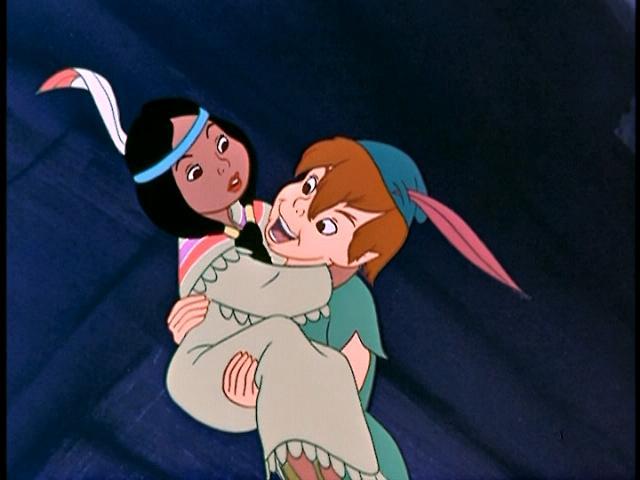
Okay, so the movie wasn't really faithful to the book, but, come on, they're adorable!

Tiger Lily, the novel, is quite haunting. It's a story told through the eyes of another, rather neglected Peter Pan character, Tinker Bell, and, as Tink tells us right at the beginning, it's a story in which good doesn't win, the girl and boy aren't innocent, and lives are lost. When we meet Tiger Lily, the girl, she's rather awkward and stand-offish, a girl who not only doesn't quite fit into her tribe, the Sky Eaters, she also doesn't quite fit into her skin. The adopted daughter of the tribe's shaman, Tik Tok, who found her under the flower for which he named her, Tiger Lily has grown up rather wild, more animal than human, more boy than girl. The only thing Tiger Lily was afraid of was Pan, the leader of the lost boys and a figure of fright for all the Sky Eaters. Until one day, when Tiger Lily lets down her guard, she's captured by Pan... and finds that more than just her body has been captured by the feral youth. As the story progresses, the lure of Peter Pan grows stronger, tempting Tiger Lily away from her friends, her tribe, and, eventually, even her sense of self. Though many ultimately suffer as a result of her neglect, tragically, it's Tik Tok who suffers the most, and it's only until it's too late that Tiger Lily returns to herself, stronger, wiser, and sadder, and attempts to mend what's been broken.

All the original story elements are there, including how the crocodile got the clock, but seen through the eyes of Tinker Bell, the classic story takes on a new and entirely fresh perspective. What really makes the story resonate is the romance between Tiger Lily and Peter Pan; it explains so much and seems so... right. So much so that when Wendy arrives, you feel Tiger Lily's pain and confusion, and her anger. Even though you know how the story does and should end, as events unfold, you still want things to end differently. You want Peter to stay in Neverland, to end up with Tiger Lily. Tiger Lily, the book, is beautiful and sad and entrancing, and it lets Tiger Lily, the character, live and breath and be more than a simple two-dimensional cartoon. As a story, the novel flows at a perfect pace, with just the right amount of drama and tension and action, in just the right places. The narrative comes alive with deft descriptions and settings, and the dialogue is evocative of each character's individuality: Peter Pan's energy and impatience come through as choppy, almost abrupt sentences; Tiger Lily's reticence and almost predatory stillness is shown in her careful way of speaking. The romance between them is shown in awkward and touching moments, moments which feel real through the spontaneity of Peter's kiss on Tiger Lily's neck or the way she holds onto him, his scent, his wildness, his fragility, even as she knows she must give him up. It's those aching moments of reality which make their romance that much more lyrical... and so heartbreaking. Watching the story unfold through Tinker Bell's eyes, you might imagine, would make scenes feel distant, less intimate. Yet it's the exact opposite: By having Tink's emotions color the narrative, everything is that much deeper, richer. At the beginning of the novel, Tink's affection for Tiger Lily adds warmth to a character who, had she been the narrator, would most likely come off as cold and distant. That affection for Tiger Lily lasts throughout the novel, even after Tiger Lily and Tink meet Peter Pan and Tink herself falls in love with Peter, her emotions towards Tiger Lily thereafter warring between devotion and jealousy. In a way, Tink acts as first Tiger Lily's, then, to a certain degree, Peter's advocate, not quite apologizing for why they do the things they do or act the way they act, but instead showing us the underlying reasons for those behaviors and asking the reader to understand them and, in some cases, to forgive them. This doesn't stop her, though, from acting as an external conscience for Tiger Lily and Peter; since she can't talk (a facet of fairy evolution which Tink explains early on), she tries to stop their bad behavior by stinging them, biting them, tugging at their clothes, and doing anything else a little bug like her is capable of doing. As a result, Tink is more than just a narrator, she's an active participant in the story; along the way, we learn just as much about Tinker Bell and her history as we do the others.

Judging by this novel, it's no wonder Anderson's 'Peaches' series is so popular and acclaimed.

Read May 22-June 4, 2012
Originally reviewed for the Amazon Vine Program June 7, 2012

Monday, June 4, 2012

"Fear the Hunter, fear the knife/Fear the edge that takes a life."


5 out of 5 stars
As Mark Twain was to the birth of American folklore, so Jane Yolen is to the next generation of Americana. Yolen is able to take classic Old World folk tales, clothe them in distinctly American cultures, mores, and histories, and present a story which gives a nod to its European roots while remaining uniquely American.

Snow in Summer is no different. At its heart, you will find the traditional Snow White fairy tale: evil stepmother/wicked witch, potions and poisons, magic mirror, the hunter, even the dwarfs who mine for precious minerals and the infamous apple (though this time it takes the form of apple kuchen). But this Snow White is set in a very rural Appalachia community, specifically a small town in West Virginia in the 1940-50's. Add in the folklore rooted in those very mountains and valleys--stories of haints and green magic, the power of rowan berries and garlic, and, most importantly, babies born with a caul--the mysterious sect of snake-handlers and their practice of faith-healing and speaking in tongues, miracle testimony and the belief in their immunity to poisons and venom, as well as those animals who have their own long and storied folktale history such as the snake, the owl, the fox, and the bear, and you've got a completely new perspective on an old story. And a beautifully haunting, lyrical, evocative perspective it is.

Snow White is known as Snow in Summer, her name coming from the little white flowers covering the yard.

description
The Snow in Summer plant, Cerastium tomentosum


We see the bulk of her story from her perspective, from the death of her mother, when she's known as Summer (because, as Summer's Cousin Nancy relates to her in a well-told tale: ”Your daddy laughed and said, 'We gonna call her all that? Snow in Summer? Don't you think she's too tiny for such a big name?' 'We gonna call her Summer,' your mama told him. 'It's warm and pretty, just as warm and pretty as she is.'”), to the arrival of Stepmama, who decided Snow was a better name (the changes in Snow in Summer's name are obvious, yet important signals in plot development), to the final, fulfilling conclusion. To add depth to the tale and to the characters, certain chapters are told from either Stepmama's or Cousin Nancy's perspectives, infrequent enough to add a piquant flavor to Snow's tale without becoming a distraction.

The novel is an expansion of Yolen's short story, "Snow in Summer," originally published in the anthology Black Heart, Ivory Bones. I'm sure I read that story as I love the anthologies produced by Ellen Datlow and Terri Windling, all of them involved with fairy tale retellings, but it's been so long ago, I'd forgotten all the details of the short story, making the book a nicely unfamiliar tale for me.


Read May 31-June 2, 2012
Reviewed June 4, 2012

Sunday, June 3, 2012

"Ever since I could remember, I had read admiration in the faces of casual passers-by."


Evelyn Nesbit. Look at her. No wonder men desired her and women wanted to be her. She was not only the first "It" girl, she was the template for the modern woman. Take away the trappings and her face could grace the covers of today's tabloids and magazines.

3.5 out of 5 stars


Breezy, gossipy, intimate, and casual, American Eve tells the tragic and riveting tale of America's first pin-up girl, Evelyn Nesbit – artist's model, showgirl, Gibson Girl – her involvement with Stanford White, literally the architect of New York City, and Harry K. Thaw, nouveau riche and totally off his rocker. This twisted triangle of lust and mania was called “The Crime of the Century” for a reason: Not only did its participants become rallying points for social reform, either as villains or heroes, the story behind the drama – inside the courtroom and out – fueled the explosion of yellow journalism and America's obsession with celebrity, sex, beauty, and scandal.

The ten years Uruburu put into this book shows, as the reader is immersed in the hedonistic excesses and rampant poverty of the Gilded Age with details pulled from period newspaper articles, personal letters, postcards, as well as autobiographies written by Evelyn Nesbit and Harry K. Thaw. However, Paula Uruburu is not an historian, but an English professor, which shows: occasionally those details can become a bit overwhelming and her prose has a tendency to be flowery and overly metaphorical; not to mention, at times, Uruburu comes up with quite the tangled sentence, requiring mental convolutions to straighten out its meaning. However, she does have a knack for channeling the lingo of the the era in such phrases as “He went into a purple frenzy...” or “...a particularly dull way to end an otherwise spiffy evening.” She also does a fine job of letting the story tell itself; while Uruburu is obviously on Evelyn's side (and, really, once you get to know her, who wouldn't be?), she doesn't make Evelyn out to be an innocent angel. That said, Evelyn's is the most prevalent voice, coming to us down the years through her two autobiographies, though Uruburu does manage to give us a glimpse into the minds of the other two big players in the story, Stanford White and Harry K. Thaw (whose autobiography Uruburu also relied on, though with more grains of salt than Evelyn's, considering the rather twisted mind from which the book came). All in all, it's a well-researched tome and it's certainly the first to truly bring to life, that I know of, all of Evelyn's story. However, while I'm not the expert on Evelyn Nesbit Uruburu claims to be, I did notice a couple of inconsistencies:  When Evelyn meets Jack Barrymore, Uruburu puts him at being 21-years-old at the time. However, from all the sources I've checked, even official Barrymore sources, Jack was 19 when he first met Evelyn, having been born in 1882 to Evelyn's 1884. Also, I thought it was weird that Uruburu wrote that Evelyn was not quite five feet tall, yet, once again, all the sources I've looked at place her at being around 5' 3” tall. Small things and I could be wrong about them, but they still stuck out for me.

What the reader notices, though, is that there is truly nothing new under the sun. The story of Evelyn, her rise and fall, the notoriety of her involvement with Stanford White and the fallout from the trial mimics the trajectory of so many starlets who came after Evelyn, right up to Paris Hilton, Lindsay Lohan, and other “It” girls who have hypnotized the masses, sometimes with nothing more substantial than the willingness to be in the spotlight, and fallen from their pedestals when it was revealed they had feet of clay. While American Eve may not be what you might call a substantial history, it is a revelational one, giving us a glimpse into the creation of cult of celebrity and, in a way, the loss of innocence. Once the seamy underbelly of their lives of decadence and debauchery was revealed, which the scions of the American power landscape tried to desperately to keep hidden for so many years, the blinders fell away; whether they liked it or not, the American public saw these men, these former idols, for the utterly human and utterly fallible beings they were. And nothing would ever be the same again.

Read May 23-29, 2012
Reviewed June 3, 2012

Sunday, May 27, 2012

I've gone Blotto for Blotto!

5 out of 5 stars

I have found a new favorite author.  It's obvious Simon Brett has a deep and abiding love for P.G. Wodehouse and Agatha Christie and their ilk, but that hasn't stopped him from taking the staples of the English-country-set cozy mystery and skewered them one by one with a red-hot cricket bat. From the amateur sleuth who's always on-scene and can find the answer to any conundrum just by licking the backside of a dust bunny, in this case Twinks, aka Lady Honoria Lyminster: [regarding two pieces of carpet fibre, one plucked from the victim's shoe, the other a sample from the victim's room] "Both pieces, as you can see, are from the same carpet. It's a Turkish fine-weave, probably manufactured in the workshop of the Hassan brothers in the village of Akgurglu just to the north of Izmir, and almost definitely originally bought from the emporium of their cousin Mustapha Khalid on the Golden Alley of the main Istanbul souk. Not that any of that's important. The important thing is that both samples came from the same carpet." to the bumbling, stumbling, plodding, thick-headed police force that's always being shown up by said amateur sleuth, in this case taking the form of Chief Inspector Trumbull and Sergeant Knatchbull: "Chief Inspector Trumbull had not been at the front of the queue when the intellect was handed out. Indeed, he appeared not to have been in the same county. But that did not prevent him from rising through the ranks of his chosen profession. Indeed, in those days for anyone in that profession to have shown intelligence or originality would have been a positive disqualification. The role of the police was to do a lot of boring legwork and paperwork, to trail up investigatory cul-de-sacs, to be constantly baffled, and dutifully amazed when an amateur sleuth revealed the solution to a murder mystery." In between are the battle-axe of a mother, the Dowager Duchess of Tawcester (pronounced "Taster," everyone knows that): "She was constructed on the lines of a transatlantic steamer and it was comparably difficult to make her change her course once she was under way." as well as various scions and breeders of the ruling class, ridiculous nicknames included, as with Twinks's brother, the Right Honourable Devereux Lyminster, who was known by one and all as Blotto: "His nickname certainly did not derive from his drinking habits. Amongst people of his class it was thought bad form for nicknames to have logical explanations; they were items to be scattered about with random largesse, like small donations to a charity."

The story here is pretty much incidental. The entertainment comes from the characters and Brett's assassination of the genre in which he's writing. By parodying the situations, the characters, the language and lingo, he's creating a pitch-perfect yet exaggerated English-country-set story along the lines of P.G. Wodehouse (most especially Wodehouse's classic Jeeves & Wooster tales), with a pinch of cozy mystery thrown in a la Agatha Christie (reminiscent of the interfering and prescient Miss Marple) though the mystery isn't nearly as mysterious as Christie's. But, again, that doesn't matter. What matters is the experiences you encounter as the story sweeps you up and gallops away, with you hanging on to the tail for dear life. Every time Blotto grows confused about a situation (which is nearly always as "Blotto's thoughts rarely ran deep enough to dampen the soles of his handmade brogues."); every time Twinks comes to his rescue (which is nearly always, with Blotto responding to her brilliance with a "Toad-in-the-hole, Twinks, you are absolutely the lark's larynx."); basically at every harebrained scheme come up by Twinks and gamely put into place by Blotto, you know Brett is skewering the genre and poking fun at the stereotypes, yet he does it so well, with such marvelous turns of phrases and side-splitting, original descriptions, that you don't care--you just keep reading... and laughing your ass off.

This is a book which doesn't require much brain power to enjoy and can be gotten through quickly. (I breezed through it in two days.) The only thing is does require is your willingness to suspend higher thinking for a while and enjoy the ride.

Read May 26-27, 2012
Reviewed May 27, 2012